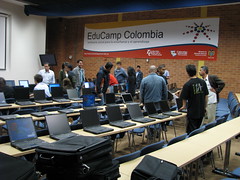
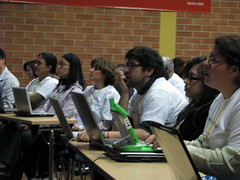
**Este post fue escrito originalmente el 26 de Noviembre de 2008, en la ciudad de Montería. Es publicado hasta ahora debido al caos tecnológico en el que me encuentro**
El taller de hoy se realizó en la ciudad de Montería. Fue mi primera vez en esta ciudad, después de ocho años.
Fue el primer taller (de los tres que hemos hecho) que no lidero de manera directa. En esta ocasión, esa responsabilidad recayó en Angelina Stephens (de la universidad EAFIT) y Carlos Estévez (de la Universidad Javeriana de Bogotá), quienes me acompañaron en el taller realizado en Bogotá la semana anterior.
Mi papel en esta oportunidad, entonces, fue mucho más discreto. Pude dibujar con mayor cuidado mi Ambiente Personal de Aprendizaje, estuve muy pendiente del backchannel del evento, y estuve compilando y organizando ideas en el wiki. Diría (no porque lo haya asumido yo) que es un papel igualmente necesario, para dejar un rastro en tiempo real de las cosas que ocurren. Y me recuerda algo que Stephen me sugería hace poco por correo: Hay muchas personas que están liderando estos temas en las instituciones, pero que están tan ocupadas haciendo cosas (ayudando a construir ese rastro de actividad) que no tienen tiempo para autopromocionarse.
Fue interesante ver la actividad en el backchannel, y observar que cuando la conversación se tornó muy desordenada, los mismos asistentes propusieron formas de organizarla (usando "categorías" encerradas por brackets -[ ]- ). Tal vez usar hashtags como alternativa habría sido útil aquí.
Conversando con uno de los asistentes, surgía una inquietud frente al aparente desorden del backchannel, y una propuesta de intentar moderarlo. No obstante, mi impresión es que este debería seguir siendo un espacio libre para que la gente exprese aquello que más le interesa, esté o no directamente relacionado con la actividad que se desarrolla.
De nuevo, aquí aparece la tensión entre controlar o modelar. Desde mi perspectiva, es mucho más fructífero modelar (mediante el ejemplo) prácticas de uso del backchannel, en lugar de tratar de controlar lo que ocurre en él.
Otra propuesta estaba relacionada con la conveniencia de proponer una pregunta en el backchannel como apertura de cada actividad que haga uso del mismo. Y esto me llevó a otra reflexión. Si bien en muchos casos una pregunta ayuda a delimitar una actividad (y puede darle sentido a la misma), para el contexto del taller resulta más importante el hecho de hacer(se) preguntas que el acto de responderlas. En ese sentido, el backchannel tendría que seguir siendo un espacio abierto.
Una vez más, aquí hay una tensión subyacente, que también es visible en nuestras aulas de clase: Las preguntas que un profesor propone tienen una intención específica (definida por él con base en un diseño curricular, en el mejor de los casos), y pueden no tener relación directa con los intereses reales de un estudiante.
Entre los asistentes se encontraban varias personas que hacen parte de la Licenciatura en Informática de la Universidad de Córdoba. Ellos también hacen parte del grupo de instituciones líderes de Computadores para Educar (programa del gobierno colombiano), y varios se encuentran adelantando estudios de posgrado en temas relacionados con el uso de TIC. Todas estas condiciones les permiten tener una amplia experiencia en el uso de herramientas Web2.0, aunque es importante señalar que otras instituciones en las mismas condiciones no tienen un empuje tan grande como el que pude observar en estas personas, quienes tenían mucho que aportar a los participantes en el taller.
Un post de Keith Lyons, menciona que Stephen reseñó en The Daily mis posts sobre los talleres, refiriéndose a ellos como experiencias de creación de comunidades de práctica. Debo reconocer que nunca los había percibido en esa dimensión. Así como no había percibido que eso fue exactamente lo que Nancy puso en marcha con su propuesta de crear la lista de correo elearningcolombia (pues la idea fue de ella originalmente). Y eso hizo que mi enfoque sobre el taller de hoy fuera diferente.
Debido a esa percepción, esta nueva serie de talleres se convertirán en una oportunidad de empezar a trabajar de manera más abierta sobre su devenir y resultados. En http://educamp.wetpaint.com estamos compilando la información de lo que ha ocurrido y esperamos que pueda al mismo tiempo servir de guía para los siguientes talleres.
Confieso que siempre me ha inquietado bastante sentir que las limitaciones de tiempo afectan el desarrollo a fondo de este tipo de acciones. Aunque no sea tan visible, el tiempo invertido en la organización de un wiki (antes y después del evento) es muy alto. Y alguien tiene que hacerlo, a riesgo de quedar con un montón de información en desorden, que resulta de poca utilidad para los eventuales usuarios. Lo cual no quiere decir que sea mi responsabilidad exclusiva. Después de todo, esa es una de las posibilidades de un wiki: compartir la responsabilidad. Ahora, siento que esta labor, tendría que estar cada vez más anclada en trabajo voluntario. Es el único modo de hacerlo sostenible en el tiempo.
Y como duda en progreso me queda por dónde seguir con los EduCamp, cómo lograr que este evento sirva como catalizador de una comunidad de práctica que empiece a tener un impacto visible. Que lidere la discusión sobre temas críticos, que cada vez menos son de exclusiva incumbencia de los "expertos" en educación (si es que existe tal cosa).
Leal, Diego. (). EduCamp Colombia 2008: Montería. Consultado en January 17, 2010, del sitio Web .Edu.Co.Blog: http://www.diegoleal.org/social/blog/blogs/index.php/2008/12/17/educamp-colombia-monteria?blog=2
Cita estilo AMA:
Leal D. EduCamp Colombia 2008: Montería. .Edu.Co.Blog. . Disponible en: http://www.diegoleal.org/social/blog/blogs/index.php/2008/12/17/educamp-colombia-monteria?blog=2. Consultado en January 17, 2010.
Cita estilo Chicago:
Leal, Diego. . EduCamp Colombia 2008: Montería. .Edu.Co.Blog. http://www.diegoleal.org/social/blog/blogs/index.php/2008/12/17/educamp-colombia-monteria?blog=2 (consultado en January 17, 2010).
Cita estilo Harvard:
Leal, D , EduCamp Colombia 2008: Montería, .Edu.Co.Blog. Consultado en January 17, 2010, en <http://www.diegoleal.org/social/blog/blogs/index.php/2008/12/17/educamp-colombia-monteria?blog=2>
Usualmente no escribo sobre estos temas, pero tengo en cola unos cuantos enlaces que me encontré hace algunos días, y una conversación reciente, así como toda la discusión que ha despertado el asunto de las pirámides en Colombia, me ha llevado a querer poner en "escala de grises" (no en blanco y negro) algunas ideas sobre cómo funciona nuestro gobierno.
El argumento central de Smolin es que es posible establecer un paralelo entre la evolución de las explicaciones cosmológicas (espacio y tiempo) y nuestros conceptos de sociedad (que se reflejan a su vez en las formas de gobierno predominantes para un período histórico determinado). No es claro si existe una causalidad entre los dos fenómenos, o si existen componentes adicionales que incidan, pero a grandes rasgos la idea es que hay tres etapas de evolución (tomadas de la presentación de Smolin):
Universo jerárquico
Todas las propiedades se definen con respecto a una jerarquía.
El observador/Dios se encuentra en un sitio perfecto, por fuera del universo.
Cosmología aristotélica
Sociedad Medieval
Universo "liberal" Newtoniano
Las propiedades (derechos) están definidas con respecto a un trasfondo eterno y absoluto de espacio y tiempo.
Todos los átomos son iguales, todos tienen propiedades (derechos) independientes de las relaciones con otros.
El observador onmisciente,"Dios", está fuera del universo
Física Newtoniana
Política liberal y teoría legal
El universo relacional/pluralista
El universo no es sino una red de relaciones en continua evolución.
Todas las propiedades son acerca de relaciones entre subsistemas.
No hay un observador ni una vista desde fuera del universo, sólo observadores internos con miradas parciales.
Relatividad general.
Teoría cuántica
Estudios legales críticos
El asunto es que, según Smolin, si no existe la posiblidad de tener una mirada del universo desde "afuera", deja de existir la noción de un creador eterno y absoluto, que pueda "imponer orden". De igual manera, el orden no puede ser explicado mediante leyes eternas. Por eso, en un universo relacional, el orden y la complejidad deben explicarse mediante procesos de auto-organización.
Por otro lado, Smolin indica que "Darwin enseña que hay procesos de auto-organización suficientes para explicar la complejidad que observamos" y que "la selección natural actúa sólo en propiedades relacionales" (por ejemplo, tal especie/individuo es más "apta" que tal otra), y luego plantea cómo la democracia se relaciona con estas ideas:
La democracia, vista desde esta persepectiva, es un proceso de evolución continua por el cual los humanos actuamos para orgnizar nuestras redes de relaciones que están en continuo desarrollo.
Smolin propone que la ciencia moderna funciona de la misma forma que la democracia:
Tanto los procesos científicos como los democráticos requieren un razonamiento a partir de evidencia compartida pero incompleta, hacia un consenso limitado pero en constante expansión.
Smolin sugiere también que la ciencia "funciona porque los científicos son miembros de comunidades éticas".
Ahora, todo esto es muy interesante, pero por momentos lo percibo como bastante "romántico". Me pregunto hasta qué punto los procesos democráticos son razonados, por ejemplo, y hasta qué punto se apoyan en la evidencia. Pienso que Smolin está ignorando por completo otras fuerzas (como las económicas o políticas, por ejemplo) que determinan en gran medida cómo funcionan nuestras democracias.
Hace algunos días, conversando con un par de buenas amigas, una de ellas opinaba lo siguiente: El sistema de gobierno más razonable es la aristocracia. Claramente, esta es una opinión controversial,y lo es debido al imaginario más fuerte que tenemos sobre lo que significa "aristocracia", el cual está asociado al período medieval. Por defecto, asociamos "aristocracia" con "nobleza" (entendiendo nobleza como la calidad de "noble", basada en títulos nobiliarios hereditarios).
No obstante, en su concepción etimológica griega, aristokratia significa 'el gobierno de los mejores'. Por supuesto, es indispensable imaginar qué significa ser "mejor" en este contexto. Pero, si seguimos el camino de Smolin, parecería que el "mejor", tendría que serlo en un sentido darwiniano. El problema es que tal sentido es claramente reduccionista, pues el impulso de supervivencia (pasar los genes a la próxima generación) que mueve a la evolución puede ser omitido para satisfacer otras necesidades inherentes a los seres humanos. En realidad, la noción de "mejor" está asociada a momentos históricos y culturales determinados.
Ahora, por su parte, democracia significa "el gobierno de la mayoría". Y no es nada difícil hallar ejemplos en los cuales una mayoría puede no sólo estar equivocada, sino ser abiertamente arbitraria. Además, la mayoría puede no incluir necesariamente a los "mejores".
Pero, si observamos a la generalidad de las personas que nos han gobernado (y no me estoy refiriendo exclusivamente al actual gobierno) parecería que en realidad estamos en una plutocracia, en donde el concepto de "mejor" está asociado al poder económico. El asunto podría ser peor, pues en la medida en que los valores estéticos cobran predominancia, podríamos terminar gobernados excluisivamente por quienes "se ven bien". Aún no estamos allí, pero el impacto de la cultura audiovisual (como argumenta Neil Postman) nos ha condicionado poco a poco a no escuchar solamente el mensaje, sino a prestar especial cuidado a cómo se ve quién lo transmite.
Una reciente decisión del Congreso parece haber afectado la contratación de empleados públicos por méritos (algo que hemos dado en llamar meritocracia), y en los periódicos se encuentran reacciones airadas de muchas personas que siguieron los procesos de selección basado en méritos que estaban siendo promovidos. Lo que llama mi atención es la forma en la cual se usa la palabra meritocracia, pues más allá de un asunto laboral, significa "gobierno de aquellos que merecen gobernar". Y otra vez el mismo asunto: qué significa "merecer"?
Al final, estoy en desacuerdo con Smolin cuando expresa su idea de democracia, pues un "gobierno de la mayoría" siempre será susceptible de los mecanismos psicológicos que afectan a las mayorías (comportamiento de manada, aversión a la pérdida, etc.).
Lo cual me lleva a preguntarme si lo que prefiero es que no exista un gobierno. Y claramente la respuesta no es esa tampoco, pues a pesar de todas sus limitaciones y equivocaciones, es la existencia de una estructura estatal la que me permite trabajar en lo que quiero y dedicarme a pensar en cosas que van más allá de la mera supervivencia. La inexistencia de un Estado (una de las ideas asociadaa con la anarquía), lejos de llevarnos a un estado ideal de libertad absoluta sin implicaciones de desorden, convertiría a buena parte (si no la mayoría de la población) en carne de cañón para el abuso continuado por parte de aquellos com mayor poder.
Pero, um, en dónde estamos entonces? Es fácil identificar en nuestro sistema actual (que se supone no es anárquico) a grupos poblacionales que son precisamente "carne de cañon" de grupos con poder. Comunidades desplazadas por violencia, familias enteras que son rehenes de sistemas bancarios (y que a veces terminan buscando dinero fácil, así sea en una pirámide). Es la misión del Estado entonces "proteger" a los "desprotegidos"?
Una pregunta como esa implica identificar quiénes son "desprotegidos", y acordar entre toda una sociedad los mecanismos para "protegerlos", lo que da para otra discusión aún más compleja, sobre todo en un país con las condiciones que tiene Colombia.
La lección personal en la que quisiera enfocarme es en que la democracia, como la conocemos actualmente, no está representando en realidad los intereses de los ciudadanos. No estamos en un sistema de gobierno de la mayoría (y tampoco lo estaríamos si fuéramos un país comunista, para poner un extremo). Y nunca lo vamos a estar, mientras los contactos (las "palancas", que parecen ser nuestra versión del "social networking") sigan siendo la forma preferida de acceder a posiciones de gobierno. Tal vez así como elegimos presidentes y alcaldes, deberíamos elegir a otros servidores públicos. Una sistema con un alto nivel de transparencia ayudaría, posiblemente, a tener un gobierno conformado por personas con mayores méritos.
Pero tal nivel de transparencia depende en buena parte de acceso a información y de oluntad de participar de manera activa en este tipo de procesos. Las dos son condiciones que parecen ser bastante escasas en nuestro país.
Pero existen algunos ejemplos de iniciativas (no he buscado en español, pues estas me las encontré de manera fortuita) que buscan ayudarnos a repensar cómo la participación ciudadana puede tener un papel más directo en las decisiones de gobierno. Llevado al extremo, un país en el cual el ecosistema informativo y participativo funcionara de manera adecuada, no requeriría concejales, senadores e incluso presidentes, pues las decisiones serían tomadas de manera directa por la población.
Es claramente utópico, pero no deja de ser interesante explorar estas ideas:
En una conferencia en la que estuve en esta semana, un participante decía que estábamos "en un evento académico y no político". Que era necesario "dejar la política afuera y concentrarse en lo científico". Para mi, está empezando a resultar imposible hacer eso. Y me pregunto hasta qué punto tal perspectiva tiene mucha responsabilidad en la situación actual que vivimos.
Es imposible dejar afuera la política, pues con cada acción que hacemos, estamos representando una visión determinada del mundo. El problema es que a menudo no somos conscientes de cuál es.
Empiezo a entender por qué no escribo a menudo sobre estas cosas. En realidad es difícil hacerlo.
On November 20 we'll begin a new series of EduCamps in several cities in Colombia. That's more than enough reason to try and finish the report of what happened in last year's workshops , as a starting point for thinking about how to improve them this year. This is the second in a series of four posts on this subject.
Starting an idea
The workshop in Bogota was the first one we did. With logistical support from CINTEL (the most important telecommunication research center in our country), we found a space designed for mass gatherings (called Logyk, if I remember correctly), where we arranged things to carry out the experiment.
After conducting several meetings with the entire CINTEL and MoE (Ministry of Education) teams, explaining in detail what we wanted to do, and showing how part of the challenge was to achieve a very open and informal (which, incidentally, was so uncommon as stimulating for all of us), we got to the day before the event (Tuesday, December 4 2007). While the staff members were putting on place tables, chairs and computers (all these hired by MoE with support from CINTEL), my previous work was to meet with Stephen and a group of students who would help us to coordinate the workshop the next day (all of them selected by CINTEL).
These students were supposed to be "catalysts" for the activity of over-the-shoulder learning. In the first meetings, we wondered what would happen if among the participants, we could not find users of any of the proposed tools. This made us consider the importance of having some knowledgeable users to start the activity. And here began the surprises. My initial assumption was that these students would have knowledge of the tools selected (by completing a total of 10) because, after all, they are "digital natives". The fact was that most of these tools were unknown to them too, although they had much experience in handling some of them (the most "social" ones).
Photo: Stephen Downes
The meeting was little more than a short description of what was supposed to happen the next day, in an atmosphere much more formal that I would have liked (a roundtable). I think this was caused, in part, by our own ignorance about what would happen. Meanwhile, staff were setting up the room where we would have the initial conference, placing tables and chairs in neat rows, in a traditional lecture format.
Putting on the t-shirt
Next morning, the registration started very early, and one of the big surprises for the participant were the white t-shirts we were giving them. Stephen and MoE staff (myself included) would have black t-shirts. The support students were dressed in red ones. The other participants would receive a white one. The t-shirt fulfilled two functions: first, to make easy for participants to tag themselves (in a previous meeting, someone suggested that people dressed with special clothing would be completely unwilling to stick adhesives to it); second, this simple garment helped to generate a sense of identity.
After many greetings and reunions with old acquaintances, and a reasonably informal atmosphere, we started the workshop.
First, a short presentation by me, talking about the structure of the National Program on Media and ICT Use (named that way at that time) and sharing with the audience what was going to happen throughout the day (IMPORTANT: This presentation is about one year old. Many things changed on the structure of the program on these months):
For those who do not want to watch the presentation, I want to highlight some "Game Rules" we defined at the beginning:
* Upon arrival, be prepared to share with other participants.
* When you leave, be prepared to share with the world.
* We are all learners.
* No one is a tourist.
* Whatever happens is the only thing that could have happened.
For me, the last one is perhaps the most important of all, and I think it speaks of something that also appeared in CCK08: It is not possible for one person to learn everything, or consume all the information produced by a large group of people . That is the world we live in. So we need to understand that we can only do what is within our reach, and that whatever that is, it is fine. Very philosophical.
Then came Stephen's talk, which was intended to provide a conceptual framework for the activities of the day:
As usual, Stephen caught the attention of the audience (not just of those who understood English, but everyone, thanks to the excellent work of the interpreters who supported the event). An interesting aspect of each person having his own computer, was discovering how many of them sought ways to record their ideas on the conference,whether by taking notes online, or using text processors and then emailing the files the themselves. (Tip: It is important to identify ways in which all participants can benefit from these notes, which we did not this first time).
After this talk, we started our work. The first thing we proposed to the participants was to draw their personal learning environment (PLE), and then start a process of peer learning (because everyone had a laptop), where everyone was expected to be both learner and teacher at the same time. The first part might not have had the impact we wanted, because I realized too late the need to expand a bit more what Stephen had mentioned on the PLE concept, and the only example I had at hand was a very raw diagram I made by hand before the workshop. (Tip: For this year, the ideas on PLE have matured a lot more. We have new elements to help participants make sense of their PLEs).
Once they made explicit which tools they used in their PLE, they would have to write down each tool in an adhesive label (that is, a tag) and put it on their t-shirt. Those labels would represent those things they knew about, those things they could teach about. They were asked to identify the tools they would like to know more about (we gave them a "tool sheet" including descriptions and URL of several tools, in 13 categories), and their mission was to find someone tagged with the tool they wanted to learn about, and ask that person to teach them about it.
With some initial diagrams, and the excuse of a coffee break in the middle of the morning, participants addressed the second part of the job, now with a much more informal atmosphere (tables and chairs were unorganized, and many people were on the space outside the auditorium, where more comfortable couches and sofas could be found). The only real requirement for this activity was a working Internet connection, for it was here where would be the greatest burden for the network. That was the only thing that was not supposed to fail.
Murphy's law
I think I heard the statement "If something can go wrong, it will" about 15 years ago, and since then (and with the multitude of paragraphs and corollaries added to it) I keep it in mind as a reminder of how those things we don't want to happen are the ones set to occur more frequently. In the case of the workshop, the only thing that shouldn't have failed, connectivity, failed. The wireless routers that were in place could not endure the burden of all users and collapsed one after another, leaving only a very small group of people online. The flaw was visible only when usage of the access points became intense (because initially, because we were in lecture mode, there were not many people using the network services). This left us in a situation quite difficult during the rest of the morning. The only solution to the problem was getting new routers, which only would come around noon.
Something that comes back to my mind, is that this incident created some tension between the organizers (including myself), because even though the response I received was "the network is not down" (which was absolutely correct from a technical point of view), the experience for everyone else was of a lousy network connection (which was unfair, given that we hired 20Mb for the day).
Photo: elearningcolombia
This situation reminds me of past situations in which engineers, ignoring completely the experience being lived by those who do not know about technical issues (and are not interested, also), try to explain that the experience they are living is not correct, and that almost everything is "running". I suppose it is a matter of empathy, and maybe it is learned best over the years ...
Anyway, participants were engaged against all odds and tried to perform the proposed tasks. All I could do was to say everyone that what we were living was something that could happen all the time, and that it was one of the challenges that we had to confront as teachers. However, it was clear to everyone that this affected the achievement of our objectives (this was expressed in the survey done after the workshop), as some of them said via Ustream:
We all tried and did our best to compensate for the situation. The students sat close to those with connectivity to support the participants. Me, I ended up sitting on the floor trying to explain the workings of a wiki using sheets of paper, taking ideas from the videos of CommonCraft. Some of them who managed to complete the mission, left traces of it on YouTube:
So, it was noon, and we went to lunch. Just before we left, the connectivity problem was solved, which led us to alter the schedule we had planned.
Plan B
Despite of everything that happened, the balance was positive at noon. Participants were very engaged and just the messy environment was for many of them a remarkable thing. But we were faced with a real problem: very few people had the opportunity to experience throughout the morning with the tools we had anticipated. There were a lot of conversations, but there wasn't that much exploration. That left us in a difficult situation for the first activity of the afternoon (which intended to collect ideas on possible ways to use the tools). For this reason, we decided to change our plan on the fly, and use the work tables in the afternoon as "demonstration stations", in which students were asked to talk about the functionality and ways to use some of the tools.
This was a case in which the idea of "Whatever happens is the only thing that could have happened" became true, even for us as organizers. And we faced the need to relax and accept that we would not achieve what we had initially imagined, but something different. Not better or worse, just different.
But this unexpected change, made on the fly, was also appreciated by some of the participants:
(This teacher talks about how recursive we were to change things and try to get them to see what they couldn't see in the morning. He's nice enough as to say that this was a "dynamic solution created on the fly")
However, not everything was perfect. We never thought the students would have to be in charge of "demonstration stations", so some of them (without liability on their part) did not have an adequate mastery of the tool they had to face. This meant that, for example, those who showed Facebook were able to show the participants what could be done with the tool, whereas there were cases (like Twitter, for example) in which for obvious reasons this activity was not so helpful. However, the situation was a great lesson who would use two days later, in Medellin.
While all this was happening, we were streaming (and recording) using Ustream. We had a video feed showed in one of the two plasma TVs we had in the room, while the other (which was outside the auditorium) was frankly underused.
The change in the dynamics meant that the activity that was planned for the beginning of the afternoon disappeared completely from the schedule. And instead of delaying everything, we continued with the rest of the agenda as we planned initially.
Our unconference
We prepared a large "board" with two half-hour slots and five tables for each slot, to complete a total of 10 possible discussions. We invite attendees to propose their topics of discussion and to sit down on the tables according to the number assigned to the discussion, and according to their own interests. The game rule here was: "If you are not learning or taking part in a discussion, please move to another one", to remind everyone that it was not required to stay in a place where they did not feel they should be.
Discussions proceeded without any problem, and then came the moment for every discussion leader to share their conclusions with the whole group. Curiously, this activity started to become kind of boring, not only because of the time (it was already 5p.m.), but because of the extent to which some participants took their points. Adding up the fact that we had 10 discussions, the discussion became longer than we would have liked it to be.
With this activity, we ended the first workshop. Due to accumulated fatigue throughout the day, we did not held a long meeting after that, but hardly discussed the critical aspects to be taken into account in Medellin, which became important lessons.
Lessons learned
Perhaps the first one is the importance of connectivity, and the need of having a plan B to make activities possible.
The flexibility in design and objectives is crucial. The building of enough confidence as to propose a change on the road is essential, and in fact constitutes a message about the use of technology: We need to change our actions depending on the context that we have around us.
The people of CINTEL proposed to play a little more with the room layout in Medellin, because we would have some space constraints. In Bogota, people left the auditorium after Stephen's conference (as there was a sort of lobby outside), which allowed us to reorganize tables and alter the space. We would not be able to do this in Medellín, so their proposal was to have a more informal atmosphere since the beginning. This messy space was, curiously, rather well received by many of the participants.
We could not make assumptions about the ability of the support students in handling the tools. We would have to do something about this situation, before the second workshop.
It was neccesary to limit the time for the final group discussion.
To finish, some opinions of the participants:
Two days later, we would have our second "trail": Medellin.
NOTE: Please let me know about mistakes and possible improvements in this writing. I tried to do a close translation of an Spanish post, so it may seem a little "funny" every now and then.
This is the first post in a series of four, in which I will be reporting and commenting on the experience we had last year (December 2007) with a couple of EduCamps (that is, workshops on the use of social software tools) we offered, from the Ministry of Education, in Bogotá and Medellín. This task is long (I mean, really long) overdue, but I finally decided to undertake it. This first post includes information about the origins, motivations and decisions that guided the design of the workshop and a link to a page on my wiki, where you can find all the wiki">detailed design (in Spanish, so far).
The second and third posts will be devoted to show a little of what happened in Bogotá and Medellín, respectively. The last one will contain some lessons learned and a sort of "toolbox" and suggestions, if you want to embark on an adventure of this sort on your own.
It is worth saying that it may pass some time to get to complete the four posts. However, I promised Stephen a long time ago to write in English about this, so it's a commitment that I really want to honor.
With that said, let's get started!
The idea of the workshops came a Saturday afternoon in Bogota (August 2007), while talking to Nancy White, Jay Cross and Fernando, a day after we finished the International Seminar on E-Learning Quality we organized back then, in which we had them as guest speakers.
Nancy mentioned that, while taking notes during the event (Nancy is a person incredibly efficient to take notes!) and reporting online what was happening , Ulf (Ulf-Daniel Ehlers, another of the guest speakers) asked about some of the tools she was using. She explained to him, and then Ulf did the same with Virginie (another guest speaker), who was sitting next to him.
This little situation was quite appealing to Nancy so, later, we ended up discussing how to organize an experience meant to foster "over-the-shoulder" learning. The ideas discussed were meant to turn into something "concrete" that what we often do with our colleagues (and even perfect strangers), when we read the newspaper of someone sitting next to us, or when we ask for help to someone sitting in the next chair in our office. In fact, this is a very common practice among programmers, for example, who share tips and solutions while working on the same computer room...
We saw that, if we wanted such an experiment to be successful, we would need each participant to have his own computer and, taking into account the intense use that both Nancy and Jay make of online tools, we would need a good Internet connection.
Back then, through my feeds I had already heard about Pecha Kucha and some of the BarCamps and PodCamps made in the United States and Europe, and about the experimental traveling unconference made in New Zealand in early 2007. I discussed about it with Jay and Nancy, and I started to see the huge importance of designing an event in which, to reproduce what I heard from Nancy and Stephen repeatedly, we could model practices of collaboration between perfect strangers, in an environment that would allow them to discover that we all can be teachers and learners at the same time.
To keep this short, in the following months I got more info about some of the various alternatives available in the unconference world (including, let's say, the OpenSpace technology and the World Café), and I started to design the overall narrative for the event.
The design document, which served as a guide to the activities of the workshop, can be found in my wiki (in Spanish only). From a static document (as released in December 2007), my wish is that it becomes a support to organizers and facilitators of this type of activity, so that's why it is a wiki right now.
As in so many other things, I have to say that the confidence that Claudia Zea and Maria Victoria Angulo gave me to launch these workshops was priceless, as well as the support of my team at the Ministry of Education (Gloria James, Karen Caceres and Francisco Suarez). The support offered by CINTEL to put in place all the logistics is equally priceless. And last but not least, the decision of Stephen Downes to join us in this new adventure was invaluable. Now, I would not say it was unexpected, because Stephen is someone with a very open mind to undertake this kind of thing, but I think it was very fortunate, because the date of the workshops matched a small space in his agenda, which allowed him to join us in Bogotá and Medellín.
Now, one may wonder why Stephen Downes and not any other speaker. The workshop is built on a background related not only to collaborative learning, but relies on concepts such as connectivism, personal learning environments and, ultimately, has to do with the possibility that each learner should have of discovering his interests (and eventually explore them with the support of technology), beyond a curriculum or some pre-defined learning goals.
During my time at the Ministry and through the inmersion I had in the blogosphere, I discovered that Downes is one of those people who not only preaches about technology, nor talks about its potential, but he takes time not only to use it, but to share, create and experiment with it. But it was not only a matter of technology. Stephen is also at the center of discussions about connectivism, e-learning and personal learning environments. That, added to the previous visits he did to Colombia, and his knowledge about the things we wanted to do, made him the best person to deliver a lecture to give some context about what we wanted to do in the workshop.
Both Nancy and Stephen, as well as Fernando and some other people, were key in debugging the initial design ideas and building the workshop narrative. To all of them my gratitude for the time they devoted to this.
So, to make a long story short, I'd like to invite you to review the wiki (that is, if you can read Spanish… I'll have to do something about that), to express your comments (good or bad) about the design (if there are any readers here who made part of it), and to join me in the report of what happened in Bogotá and Medellín.
 A excepción de que se indique lo contrario, este contenido está publicado bajo una licencia Creative Commons.